Interesting blog post about the potential of using data to drive public policy decisions, as opposed to our current "politics first at all costs" mess. Not to make a political statement here, but regardless of your political persuasion the current polarized environment is anything but effective. I wouldn't mind giving data a real chance as the author suggests. You can read the post here.
Showing posts with label Metrics. Show all posts
Showing posts with label Metrics. Show all posts
Friday, August 10, 2012


Monday, May 28, 2012
Count the Paper Clips

If
you read this blog even occasionally you know that I am a big fan of data and
metrics in managing the FM domain. Our
group routinely tracks, analyzes and reports data on the full breadth of
services we perform. As a result we are
tuned in to the pace of our business and can almost feel minute shifts that
signal change we should be aware of.
We
are now reaping the daily dividends of a grass roots effort begun several years
ago when “count the paper clips” first came into our lexicon. That was the direction given when a manager
asked, “What should we count?” upon hearing that we were going to undertake a
metrics program. It was a brilliant
answer.
That
response started us immediately. If we
had said, “Let’s design a program. We
need a system before we can start,” or asked “Who has the knowledge and
skillsets we need?” we would have been stalled at the start. The answer “count the paper clips” mobilized
us to immediate action. We did not have
a system, program, or organizational structure, but we knew we could count them
and we did. While we were at it, we
counted everything else.
As
a result, we now have data going back several years on every facet of our
operation. Over time our capabilities
and sophistication have grown. When we
started we knew how to count. Today, we
capture, analyze, project, and plan strategically based on what we know for
certain and can predict with high accuracy.
We can anticipate shifts in business patterns before they occur based on
well established relationships between disparate data points.
The
payoff for us is not simply that we are able to do a better job with greater
accuracy. The job is also more fun. By enabling our staff with training and
giving them a vision we have allowed them to learn, participate, discover, and
grow. The great bulk of the work is
accomplished by line staff who are in direct contact with systems, processes,
and customers. Virtually all team
members have been trained in basic statistics including data gathering, data
structure, pivot tables and pivot charts, data smoothing, analysis, and how to
format and report operational data.
This
metrics initiative fueled the start of our Continuous Improvement initiative
when it came along soon after. Unlike
some others, the Facilities staff knew and understood the importance of data
driven planning and were familiar with the routines and discipline required to
be effective in the quality improvement effort.
Every
month line managers gather to review metrics and analyses that have been
produced by staff. We track and analyze
details to identify trouble spots and opportunities. We investigate causes, analyze data, and adjust
operations. We have seen our Customer Satisfaction scores improve markedly
while getting more done and focusing our efforts on what really matters. We work hard at it and the results show
it. Our group is rightfully proud of
their abilities and we serve our organization better than we did before.
And
it all started with counting paper clips.
Saturday, February 11, 2012
Applying Lean Six Sigma to Facilities Management
Note: This is the first installment of a two part series on Lean Six Sigma.
Two Disciplines with Common Goals Combine to Improve Operations and Profitability
More than ever before companies are under pressure to improve operational efficiency and bottom line profitability. It does not matter if your business is manufacturing, service or knowledge based; all are under the same pressures. Increasingly companies are turning to Lean Six Sigma as a strategic tool to achieve measurable improvements at the bottom line, reflecting the results of changes made throughout the value chain, including internal processes, suppliers and most importantly customers. As a facility management professional you have likely been challenged to keep pace and may have wondered if and how these principles can be applied to your organization. Rest assured that they can be, and that your staff and internal customers are up for the challenge. As with any Continuous Improvement (CI) program strong leadership and commitment from the top is a requirement. Your understanding, sponsorship, and support will help launch and sustain the effort.
What is Lean?
The term “Lean” was first used in reference to quality improvement systems when it was applied to the Toyota Production System (TPS) in the nineteen eighties. Reduced to its basic premise, the system seeks to improve process efficiency and quality by increasing speed and eliminating waste. Students of TPS will be familiar with the concepts and methodologies of Kaizen, the never ending effort to discover and eliminate all forms of waste in a process. While originally developed during Japan’s post-WWII recovery to improve manufacturing quality and efficiency it is now routinely applied to all forms of work processes.
It is a gross mistake, however, to think of Lean as a one-time project or improvement effort. It is about establishing a new culture that pervades the organization and becomes a part of its very DNA. It does not happen overnight, but it can (and should) happen more quickly than you might think. This rapid adoption occurs best where strong leadership and commitment are obvious to all, setting an expectation. Including Lean participation and results as a part of performance management signals to every worker at every level just how important it is. Lean should be viewed as a journey. One that can begin with early results to be sure, but those first positive outcomes should not lead to a declaration of victory and the sure to follow loss of interest.
Remember that the two prime points of focus in Lean are increasing speed and eliminating waste to improve overall quality and value. To achieve this Lean practitioners take a customer view of every process and outcome, looking to improve customer value in terms defined by the customer. Value stream mapping will identify areas for rapid waste elimination opportunities while flow management will optimize the sequence of process steps. Allowing customers to control the pace of production through pull management systems that deliver products and services based on actual consumption need prevents the waste of over production and the transportation and storage activities associated with it.
Lean’s attention to eliminating waste evaluates all areas of value provision. Defects such as bad product or service quality and missed deadlines cause rework and increased resource utilization. Over producing consumes materials and adds time cost as well as transportation and storage. And lest you be thinking to yourself, “I see how that applies in a manufacturing environment but what effect does it have for my service organization?” think about the costs associated with your service quality shortfalls, the cost of bad information that leads to bad decisions, or the hidden costs of over-provisioning to provide contingencies that may never be required.
Lean’s three basic components; Quality, Just-In-Time, and Stable Operations often require a different way of thinking about the work of the enterprise. Where most are focused along functional lines Lean requires a re-focusing to improve efficiencies throughout the value stream.
What is Six Sigma?
Six Sigma is essentially a statistical regime that improves process effectiveness by reducing process variability and improving process yield. It is a collection of various statistical and analysis tools which are used to discover process defects, and a set of methodologies for curing them. The term “Six Sigma” represents 3.4 defects per one million opportunities. Compare that to the average manufacturing quality level of three sigma, or 67,000 defects per million, and think about the human, material and opportunity costs associated with the difference between the two. Not in manufacturing? Then think about your service processes and the cost of your defects when applied to your corporation’s cost of producing its products or services. Customers pay that cost and they know who provides the best quality at the best price. Customers know where the value is.
Interestingly, the Six Sigma “movement,” if one can call it that, began in the eighties when Motorola took on the challenge of reducing product defects as a way of improving market position at about the time Toyota was inventing its Lean processes. Like Lean, Six Sigma is best thought of as a philosophy and culture that is customer focused, in which the customer defines product or service specifications and the provider meets those needs with optimized efficiency.
The goals of Six Sigma are much the same as those of Lean but it approaches these from a statistical perspective. Decreasing process complexity, reducing cycle time, and minimizing defects all contribute to increased customer satisfaction and all can be measured, mapped, analyzed and improved.
All quality improvement programs include improving financial performance as a goal. Six Sigma, however, uniquely equips an organization owing to its statistical nature and allegiance to empirical data and the scientific method of investigation. Pre-project scoping analyses of financial benefits allow management to prioritize projects based on expected beneficial outcomes. Continuing financial analysis during project evolution keeps the team focused on delivering bottom line results by fine tuning the project. This also provides management a view into the project’s progress as it evolves, thereby improving and speeding intelligence on “ground level” operational developments. At the same time it informs management the financial analyses educates the team members and allows them to recognize other opportunities for improvement.
Next week: Combining Lean and Six Sigma, and a shared services implementation case study.
Sunday, October 9, 2011
Procurement Diligence Pays Dividends - Part 2
Requirements planning is a key first step. It is important to be forward leaning, anticipating organizational and key customer requirements ahead of initial requests. This proactive behavior is built upon two foundations; relationships that enable anecdotal and hard data information sharing as needs first begin to emerge (long before they are normally translated into a requirements request), and strategic alignment of the FM operation with enterprise goals and activities. Having the advantage of these two perspectives allows the FM leader to forecast properly and bring creative contributions to bear. Importantly, requirements planning improves the quality of investments made, thereby contributing to capital preservation which in turn improves leverage. Optimizing the requirement minimizes unproductive expenses and helps optimize the supply chain, both of which improve the overall value of any given requirement.
The specification process establishes criteria for successful outcomes. Whether you are looking for a new robotic manufacturing system, land for a new headquarters building, a new maintenance or service provider, or an improved contract for office supplies; the specification you approve establishes your expectation of what is acceptable. As such it warrants diligence and serious consideration. You may consider the specification to be the floor against which you will evaluate options, whereas providers may consider it the ceiling as well. This is an important distinction and demands clear articulation in the resulting specification. Further, the specification process should include in collaboration and consensus among the full range of stakeholders for any important product or service.
Market assessments inform acquisition strategies. Consider the assessment as your opportunity to understand the full breadth of requirement fulfillment options. A formal and standardized assessment will yield market forecasts for any product or service, including relative competitive alignment among providers, their strengths and weaknesses, and how well their offerings align with your needs. Do not under appreciate cultural alignment as a learning outcome of this effort, especially if the products or services you will procure from them are of strategic importance. It is often valuable for the internal team that has conducted the assessment to come together at the back end and share individual learnings and questions. What can we do different than we normally do? What is now possible that we didn’t realize when we started this process? These are important questions that should be answered and provide feedback to the requirements and specifications processes.
Investigation should include analysis of metrics that predict likelihood of instability. This type of investigation looks at performance quantification in areas that highlight unstable operations or high risk potential. Think of this as identifying and then quantifying Key Performance Indicators (KPI’s) for a provider’s overall business. If dealing with a commodities contract for example, one might evaluate the supplier’s performance against their production plan, the number of delayed shipments, the volume of product returns, how often the supplier must be expedited, and how accurate their marketing forecast is. This information will tell you how accurate their internal business processes are and where there may be hidden stress in their systems. If the contract you are considering is of high strategic importance to your own operations then these information points are especially important. These are not the kinds of questions FM’s normally ask in a sourcing exercise but they can be illuminating, revealing hidden risks that no marketing department or account representative is going to share.
FM’s spend a lot of money, one reason why the function was traditionally thought of primarily as an expense line item in the purest form. The profession has increased its sophistication and strategic visibility largely because it is now recognized as a valuable contributor to corporate direction and health. Attention to detail has always been a hallmark of the FM activity and that is not changing as the profession elevates its profile. It is, in fact, because we have been successful in marrying the boiler room with the board room that we have been able to achieve this. Both elements are critical in our evolution. The kind of diligence and rigor toward the purchasing activity so important to the FM and suggested here is the same diligence that drives our increasing recognition as a value add function.
Strategy and goals are one thing, execution is everything.
Monday, September 12, 2011
Baseball, Data, and Facilities Management
A
friend recently sent me a link to a LA Times op-ed piece that used Sandy
Koufax’s 1965 perfect game as a data collection object lesson. This was of interest to me because I was a
big Koufax fan (the only time I ever cut class was to watch him pitch his gem
against the Minnesota Twins in the ’65 World Series) and I have an interest in
data as it relates to the world of FM.
The article is both enjoyable and informative, and makes a couple of
points relevant to those of us who collect, analyze, or use data.
You can never have
too much data
Often
people choose not to collect certain bits of data because they do not have or
know of a current need for it. As the
author points
out, however, we sometimes later wish we had data that we could have had if
only we had collected it. With new analysis systems and protocols we can
learn things from old data that help us today.
The example he uses in the article is how collecting additional pitch count data
changed the way pitchers are used, thus extending their careers and value. This data always existed but was not collected prior to the 1980's. The potential benefit of the data existed but was unrealized because it had not been collected.
Investigating
old data can lead to new learning, which in turn results in improved operations
and services. Our FM group is a case in
point. For years we have been collecting
and using data on the full spectrum of services and operations. We collect much more data than we analyze or
report, but when we need it, it is there.
For example, we have millions of lines of BMS data which allows us to
conduct rigorous analysis and troubleshooting when needed.
The point is that we did not have a specific need for the data when we
started collecting it. We just did
because we could. Now, having that data
available opens the door to important insights.
It allows us to investigate root causes, to map relationships among
various indices, and to gain valuable knowledge and wisdom that contribute to
improved designs and process modifications.
Home run or hit-and-run?
Some
baseball fans love the power game, as evidenced by the popularity and
predominance of power hitters. Others
enjoy the nuance of the tactical game.
In the business of process improvement, however, the advantage goes to the
tactical, the nuanced changes. In business it is rare that you can achieve a large and dynamic change, a “homerun” that
dramatically improves operations. It is
much more likely that improvements will be incremental with accumulated effect
over time, much like a single, hit-and-run, stolen base and sacrifice fly will result in a run scored. None of these represent a run by themselves
but each is a key part of the sequence that produces in the end. Would you rather take a big swing with lower
odds of success, or spend the time to gain clarity and swing at exactly the
right spot, at exactly the right time, with exactly the right force? The answer is obvious, isn’t it?
Foresight and
imagination enable discovery
Understanding
at the earliest stages of a data collection project that you do not and cannot
know how that data may eventually be used is an important point. It allows you to take a wider approach to
collection and a more diligent approach to the care of your data, and suggests
a healthy inquisitiveness and respect for the unknown that lies in the
future. Data
that has been diligently collected over time can be synthesized to investigate
specific issues and discern patterns, leading to understanding and
improvement. This may come in the form
of a revised process or identification of a problem or opportunity. Regardless, the result is improvement.
Finally, understand that data survives individual systems. Systems come and go. They become obsolete and get replaced, or a new vendor may bring a new system into your operation. Regardless, the data is tangible, it is yours, and it is a hard asset. Treat it that way both in how you care for it and how you protect your legal ownership rights to it.
Take care of your data, and your data will take care of you.
Friday, September 9, 2011
IFMA Launches Benchmark Data Exchange Utility
BEX is IFMA's new benchmark application which allows you to compare building data in real time. Check it out here. From IFMA's news release ...
Once enough data is collected to build a report, you can:
Nonparticipants may purchase an annual subscription starting at US$179.
Once enough data is collected to build a report, you can:
- Access survey data to compare hundreds of building reports to your facility’s data.
- Filter benchmark data specific to your needs—sort by industry, facility type, geographic region, facility size and more.
- CURRENT SURVEY: IFMA’s Benchmarks 6 - Annual Facility Costs
- COMING NEXT: Operations & Maintenance Benchmarks
- COMING SOON: Space & Project Management Benchmarks
Nonparticipants may purchase an annual subscription starting at US$179.
Sunday, May 15, 2011
Using the Balanced Scorecard to Improve Strategic Alignment
The building blocks of strategic alignment; business strategy, FM strategy, organizational infrastructure and processes and FM infrastructure and processes, combine with strategic fit and functional integration to act as the foundation upon which real alignment is built. While understanding this conceptual base is necessary, it is only the base. Strategic alignment is an ongoing process and can sometimes be hard to discern, given its conceptual nature. That is where the balanced scorecard comes in, providing a way to measure FM strategies and outcomes in a way that is clear, relevant to the business, and actionable.
A balanced scorecard measures four dimensions; financial, customer, internal processes, and innovation/learning. This broad view of the business, as opposed to a traditional financial or operational metrics only view, provides a deeper perspective of current operating performance and future performance drivers. Because of this broad view perspective, the balanced scorecard is best viewed as a management system, not a performance indicator.
 To build a successful balanced scorecard for FM organizations you must address each of the four dimensions.
- Financial Perspective: How is FM maximizing shareholder value?
- Customer Perspective: How is FM performing in ways that matter most to its customers?
- Internal Process Perspective: What are the factors needed to build strategic capabilities and efficiencies?
- Innovation and Learning Perspective: What are the knowledge, skills, and systems needed to sustain continual improvement?
You can see how these four dimensions act upon each other. Learning, for example, supports continuous improvement of internal processes which in turn results in higher customer focus and satisfaction. By linking the four dimensions of the FM balanced scorecard to enterprise strategy FM’s help align their unit strategy with the overall strategy of the business.
This linkage to enterprise strategy is critical. Many FM’s have balanced scorecards that are FM centric, focused primarily on traditional FM metrics. While this may indeed indicate how well your operation is performing in relation to broad based FM benchmarking metrics, it may do little to illustrate how your FM department is supporting or hampering the overall goals of your specific business.
And that is the point, isn’t it? Understanding how FM relates to your overall business, how you can provide positive support to the enterprise, how you can leverage FM to the benefit of your business are all good things to do.
In today’s business world being able to demonstrate value and leverage are two critical elements of success. Those who do these well are at a strategic advantage. They can explain FM value and importance in specific business-centric terms, they demonstrate attention to improving customer outcomes, they learn and innovate to the benefit of the enterprise. In doing all of this they act as thought leaders, anticipating and fulfilling the needs of their organizations, aligning FM with the enterprise at strategic and operational levels.
Is that you? Does it sound like your FM group?
It should.
Sunday, April 3, 2011
Aligning FM with Enterprise Strategy – What Works?
Aligning functional operations and strategy with enterprise strategy first requires correctly understanding what alignment is. I think the best practical definition I’ve run across is from Y.E. Chan who says,
“Alignment is best described not as a uni-dimensional phenomenon but as a superset of multiple, simultaneous component alignments that bring together an organization’s structure, strategy, and culture at multiple levels, with all their inherent demands.”
Multi-dimensionsal, simultaneous, and I would add, ongoing alignments. Sounds like a messy process and it sometimes can be. But there are a number of tactics that will help to make the alignment process successful.
A top down approach with a clear focus on business strategy is essential. The changes required during serious alignment projects often require top-down motivation to overcome inertia and turf issues. Senior executives are closer to enterprise strategy and have the ability to exert influence across the organization, and the ability to fund technology and other initiatives.
The alignment framework must be strategy driven. It’s all about consistently applying the same key strategies across the organization in a manner that maximizes adoption, market reach and shareholder value. If the framework is focused on non-strategy issues then the lack of a unifying driver can present obstacles that stymie the effort.
Operational metrics and customer satisfaction help to drive alignment initiatives. Metrics to the rescue, again. It’s hard to align something that you do not clearly see or understand. Correctly quantifying operations and customer satisfaction provides a way to measure alignment gaps and prioritize projects based on expected benefit and importance to successive alignment initiatives.
Adopt continuous improvement and six sigma as alignment tools. Hopefully you have already been using continuous improvement and six sigma protocols to optimize your own processes. Alignment initiatives present the opportunity to take this to the next step, expanding the boundaries around your processes to include outside functions in which there is an important relationship in either direction.
Revisit mission statements to assure relevance and alignment. It may sound obvious (because it is) but many organizations have not aligned their mission statements to be complimentary of each other. If these statements are indeed the pointer on your compass to success, then different parts of the organization are moving in different directions at different speeds and with different levels of concern. Making sure that mission statements express common values and outcomes all the way down the line helps everyone keep their eyes on the same goals.
Make alignment important to everyone. You think it is now? Maybe. Making alignment a reportable element that influences performance reviews and compensation will guarantee it gets the attention you want it to get.
Monday, February 14, 2011
Assessing Facility Management Performance
Providing workplaces that meet organizational needs and services that support business operations is what FM’s do. Sometimes, however, it seems like that is the easy part. Knowing exactly what to do and how to go about it can sometimes be a challenge. Even more perplexing at times is understanding how well you are doing and what your customers think of your performance. To help us we have all kinds of performance analysis and management systems, balanced scorecards and the like.
Sometimes I think we over complicate it. What we really want to know can be revealed by the answers to a few simple questions. By properly structuring these questions and aligning them with core principles and tools we open the door to knowledge that improves our processes and increases our value. These simple questions and their affiliated processes are the heart and soul of performance management and improvement.
Who do you serve and what do they do? Understanding your customers and stakeholders is the foundation that supports everything you do. Here is a key fact to always keep in mind: You cannot understand your stakeholders if you don’t know what they are concerned about, and you can’t know that unless you ask. So ask. Be intentional about your relationships with key stakeholders. Their business is your business. Learn it. Start to think and talk in terms of their strategies and goals. Demonstrate to them that you both know and understand their business.
What services do they need? Now that you understand their business, ask what services you can provide that will help them be successful. This is your chance to do the expected well and to surprise with the unexpected. While everyone needs the basics you will find customers who need something else, maybe even something they haven’t realized yet. Knowing your customer’s business at a fine level gives you the ability to see their needs from your perspective. Providing options to improve their value demonstrates FM’s strategic importance and leverage.
What is the best way to provide those services? Evaluating your workflow process is a critical step in making sure that your processes are aligned to maximize benefit across the enterprise. Too often we design and evaluate FM processes and workflow from a FM perspective only. Because of the breadth of our reach our workflow processes touch virtually every nook and cranny of our organizations. It behooves us then, to assure that our workflow is efficient, thorough, and well-aligned. Also, FM sometimes needs to be more assertive in driving workflow alignment throughout an organization. Yes, we serve every nook and cranny; but we also are served by many. We need information and process outputs from others to do our jobs well. When we aren’t getting it we have a responsibility to speak up.
How can you know you are doing a great job? Sustainable metrics are the protein in your FM diet. Metrics provide data, knowledge and eventually, wisdom. Metrics tell you what you are doing, how often, how fast, how well, and how efficiently and effectively. Understanding what is important to your organization, how to measure it accurately, how to analyze the data and glean operating intelligence from the data is a core FM skill set. Some of this information will come from your customers, as it should, but only a small fraction. Those who rely on a limited number (usually less than 5%) of survey returns to portray their operational health do themselves and the enterprise a disservice. You should be tracking and reporting basic numbers and trends for all segments of your FM operation as a minimum. You should also be using metrics to investigate operational alignment with key organizational goals, to troubleshoot when necessary, and to help make the business case for projects and initiatives.
What is the best way to organize? The correct organizational structure is the foundation upon which your strategy and execution capabilities rest. Depending on your company’s size, services/product, complexity, geographical arrangement and the market sector you are in, you may elect to provide all services in-house, out task discreet elements, or outsource the bulk of the FM effort. If outsourcing you might elect different providers for different FM elements, or select one provider per region, or even one global provider. The options here are almost endless and most likely more than one will work for you. But some will work better than others. Understanding the service and competitive advantages and disadvantages of the various organizational models and how they relate to your specific requirements and culture are important steps to knowing your best option. This is truly a foundational issue and getting it right is critical. Do not make changes to your structure without a strong due diligence effort to identify risks and mitigation strategies.
Sunday, January 2, 2011
Using Metrics to Enhance Continuous Improvement
If you are like the vast majority of FM’s you are now much more familiar with Metrics and Continuous Improvement programs than you once were. Hopefully you have metrics that measure the important parts of your business accurately, and a system for routinely analyzing and reporting data. Good data collection and analysis practices are at the very heart of meaningful metrics outputs. Measure the wrong things or measure incorrectly and you are at risk of making wrong decisions. Measure correctly and you have a gold mine of opportunity.
Ah, but that is the rub, isn’t it? We have all of this information now, but what are we supposed to do with it? Simply making charts to flash on the screen doesn’t seem like much value for the investment made in developing the data. It’s not. The real value of metrics programs is in the change they lead to. Change, as in “Continuous Improvement.”
Organizations that link their Metrics and Continuous Improvement efforts take advantage of the knowledge gained through data to direct efforts to improve operations. This is a key linkage that increases the return on investment from the metrics program, helps fine tune data processes, and increases the speed of Continuous Improvement.
Continuous Improvement programs that are targeted based on accurate data yield far more beneficial results than those that are not. This is because data driven Continuous Improvement projects apply leverage to those processes in an organization that really matter and have the greatest potential to improve performance.
As an example, let’s take a look at a classic FM service issue through the lens of a data-targeted Continuous Improvement process and one that is not.
The Issue: Customer Satisfaction ratings on hot/cold work orders appears to be declining over time.
Untargeted Approach: Analyze hot/cold work orders for Mean Time to Repair, Mean Time Between Failures, Mean Down Time, etc. to determine which sub-processes appear to be out of control. Investigate and revise those processes.
Data-Targeted Approach: Analyze Customer Satisfaction rating data at a fine level to determine which element(s) of the process is driving the rating decline. Develop a Continuous Improvement project to address those elements.
The difference between the two approaches is that the untargeted approach assumes the entire process is part of the problem, while the targeted approach looks at data to identify the key elements(s) of the problem, thereby concentrating improvement efforts where they matter most.
Interestingly, the untargeted approach may indeed improve the overall process yet not improve the Customer Satisfaction rating. For example, a targeted approach may identify that customer dissatisfaction is based in lack of communication and ambiguity regarding the work order status or close out.
Metrics programs are about discovering data, seeking knowledge from the data, and then turning the knowledge into actionable wisdom. Continuous Improvement programs are about applying systematic problem analysis methodologies to important issues in order to effect positive change in the Quality, Time, Cost and Customer Satisfaction dimensions.
Using data to target Continuous Improvement efforts increases the metrics program ROI and accelerates the pace of operational improvement. That seems like a positive outcome for both, and for you.
Sunday, July 25, 2010
Is There A Number for Everything?
“We must consider the possibility that if we can’t measure something , it might be the very most important aspect of the problem.”
That from a blog post by Roger Martin, Dean of the Rotman School at the University of Toronto and one of today’s preeminent business thinkers.
It does raise an interesting question which I think is relevant in the FM domain. Have we become so focused on measuring, metrics and quantitative analysis that we have lost sight of the “soft” side of our business? And, exactly what are the elements we cannot measure but which are important never the less?
Is emotion an important business value? What about motivation, caring, empathy, mentoring, experience, and instinct? I would argue that all are important values and that we too often do a poor job of balancing them against the hard numbers we measure our performance by every day. SLA’s and KPI’s are fine but they do not present a whole picture of your performance or business health.
Take a look at your own organization and ask yourself, “Are we emotionally healthy around here? Which is correct most often, the spreadsheet projections or my gut?” You might be surprised at what you learn.
That from a blog post by Roger Martin, Dean of the Rotman School at the University of Toronto and one of today’s preeminent business thinkers.
It does raise an interesting question which I think is relevant in the FM domain. Have we become so focused on measuring, metrics and quantitative analysis that we have lost sight of the “soft” side of our business? And, exactly what are the elements we cannot measure but which are important never the less?
Is emotion an important business value? What about motivation, caring, empathy, mentoring, experience, and instinct? I would argue that all are important values and that we too often do a poor job of balancing them against the hard numbers we measure our performance by every day. SLA’s and KPI’s are fine but they do not present a whole picture of your performance or business health.
Take a look at your own organization and ask yourself, “Are we emotionally healthy around here? Which is correct most often, the spreadsheet projections or my gut?” You might be surprised at what you learn.
Sunday, July 11, 2010
Three Pivot Points That Are Influencing the Future of FM – Part 3
This is the third and final in a three part post on issues the author feels are affecting the FM profession
Pivot Point: The Explosion of FM Data
As building operations have increased in complexity over the years so has the data available from building systems and the need to analyze data and make fact-based decisions. FM’s and their cohorts are challenged to make sense of and synthesize data from different systems to present a complete and rational picture of operations. Not to say that we have arrived at a juncture of data and rationality, but at least we can see the intersection from where we are today.
Expanding beyond the building envelope, managing portfolios of multiple properties only increases the complexity of the equation and the challenge of reaching that desired intersection. While there have long been portfolio management systems and building management systems the two have not often worked hand in hand. Too often, in fact, they have not been viewed as part of the same equation. The real estate folks have their systems and the operations team has theirs. Seldom are they integrated.
In today’s world that simply is no longer acceptable.
Large portfolios represent large investment that must be optimized in all dimensions to support financial health and strength. That means that real estate portfolio management and operational systems management should be viewed as part of one whole, not two separates.
Corporate Real Estate (CRE) professionals care about strategic planning, forecasting requirements and business drivers. They understand the financials of the deal but not necessarily the life cycle operating costs of the deal. They need to track inventory, utilization, depreciation and implications to the corporate bottom line. Like FM’s, their operational cousins, they typically deal with a number of different systems to accomplish all of this.
FM’s who are focused on building or site operations deal with a different set of requirements, systems and data. On the building side of their domain they care about operating costs, risk mitigation, compliance issues, energy efficiency, lean processes and meeting service level agreements.
The two worlds seem different but are interdependent. New generations of software will integrate them in ways that improve operations on both sides of the equation, making the interdependencies visible and actionable. Portfolio information about asset management and utilization will help operators understand building profiles. Service KPI’s will be tracked across the enterprise and integrated with financials. Energy management will be dashboarded and enable financial modeling and troubleshooting using the same analytical tools.
One of the positive effects of the economic meltdown will be an increased focus on efficiency coming out of the experience. Capital investment will flow to programs and systems that help to lean operations, improve performance and increase efficiencies.
The Open Standards Consortium for Real Estate (OSCRE) has taken on the challenge of expanding the alignment agenda beyond organizational boundaries, with the goal of unifying core processes industry wide, including standardizing how information is shared. OSCRE aims to accomplish this by establishing standards that will be the framework for unifying information flow and execution. Already, standards for Work Request and Work Order Fulfillment, Lease Abstract Exchange, Lease Delivery, Occupiers Cost and Portfolio Information Exchange are in place, with others such as Investment Valuation in process. OSCRE has plans for the operational side of FM as well.
“Facilities Management: An interest group is forming to extend the seminal work on neutral work request and work order exchanges. Work management is fundamental to many categories of capital asset management, accommodations, and maintenance management. This group will first establish market drivers for ongoing initiatives and then start multiple technical workgroups and/or engineering initiatives.”
Excerpt from OSCRE website
FM organizations are now awash in data. But what are we doing with it, and how are we doing it? Is it coherent and meaningful data, or are we simply counting to count? How effective are we in gleaning wisdom from data, and what changes as a result? These are key questions to be dealt with if you have not already. Now and more so in the future, the FM suite will be home to analysts who sift data and look for patterns and trends, discerning nuggets of information that reveal truth, risk and opportunity.
There are others of course, but these three pivot points are vital to our profession in the coming years. Understanding the implications of the social and economic changes that seem to be everywhere these days, aligning ourselves and our organizations to improve speed and agility, and taking advantage of the information explosion are all first level concerns that demand diligent attention and action.
Our world is not the same as it used to be. Most people realize that fundamental changes are occurring. Those who interpret this as good news, as a chance to create and achieve will embrace the changes required to turn opportunity into reality.
Pivot Point: The Explosion of FM Data
As building operations have increased in complexity over the years so has the data available from building systems and the need to analyze data and make fact-based decisions. FM’s and their cohorts are challenged to make sense of and synthesize data from different systems to present a complete and rational picture of operations. Not to say that we have arrived at a juncture of data and rationality, but at least we can see the intersection from where we are today.
Expanding beyond the building envelope, managing portfolios of multiple properties only increases the complexity of the equation and the challenge of reaching that desired intersection. While there have long been portfolio management systems and building management systems the two have not often worked hand in hand. Too often, in fact, they have not been viewed as part of the same equation. The real estate folks have their systems and the operations team has theirs. Seldom are they integrated.
In today’s world that simply is no longer acceptable.
Large portfolios represent large investment that must be optimized in all dimensions to support financial health and strength. That means that real estate portfolio management and operational systems management should be viewed as part of one whole, not two separates.
Corporate Real Estate (CRE) professionals care about strategic planning, forecasting requirements and business drivers. They understand the financials of the deal but not necessarily the life cycle operating costs of the deal. They need to track inventory, utilization, depreciation and implications to the corporate bottom line. Like FM’s, their operational cousins, they typically deal with a number of different systems to accomplish all of this.
FM’s who are focused on building or site operations deal with a different set of requirements, systems and data. On the building side of their domain they care about operating costs, risk mitigation, compliance issues, energy efficiency, lean processes and meeting service level agreements.
The two worlds seem different but are interdependent. New generations of software will integrate them in ways that improve operations on both sides of the equation, making the interdependencies visible and actionable. Portfolio information about asset management and utilization will help operators understand building profiles. Service KPI’s will be tracked across the enterprise and integrated with financials. Energy management will be dashboarded and enable financial modeling and troubleshooting using the same analytical tools.
One of the positive effects of the economic meltdown will be an increased focus on efficiency coming out of the experience. Capital investment will flow to programs and systems that help to lean operations, improve performance and increase efficiencies.
The Open Standards Consortium for Real Estate (OSCRE) has taken on the challenge of expanding the alignment agenda beyond organizational boundaries, with the goal of unifying core processes industry wide, including standardizing how information is shared. OSCRE aims to accomplish this by establishing standards that will be the framework for unifying information flow and execution. Already, standards for Work Request and Work Order Fulfillment, Lease Abstract Exchange, Lease Delivery, Occupiers Cost and Portfolio Information Exchange are in place, with others such as Investment Valuation in process. OSCRE has plans for the operational side of FM as well.
“Facilities Management: An interest group is forming to extend the seminal work on neutral work request and work order exchanges. Work management is fundamental to many categories of capital asset management, accommodations, and maintenance management. This group will first establish market drivers for ongoing initiatives and then start multiple technical workgroups and/or engineering initiatives.”
Excerpt from OSCRE website
FM organizations are now awash in data. But what are we doing with it, and how are we doing it? Is it coherent and meaningful data, or are we simply counting to count? How effective are we in gleaning wisdom from data, and what changes as a result? These are key questions to be dealt with if you have not already. Now and more so in the future, the FM suite will be home to analysts who sift data and look for patterns and trends, discerning nuggets of information that reveal truth, risk and opportunity.
There are others of course, but these three pivot points are vital to our profession in the coming years. Understanding the implications of the social and economic changes that seem to be everywhere these days, aligning ourselves and our organizations to improve speed and agility, and taking advantage of the information explosion are all first level concerns that demand diligent attention and action.
Our world is not the same as it used to be. Most people realize that fundamental changes are occurring. Those who interpret this as good news, as a chance to create and achieve will embrace the changes required to turn opportunity into reality.
Wednesday, April 7, 2010
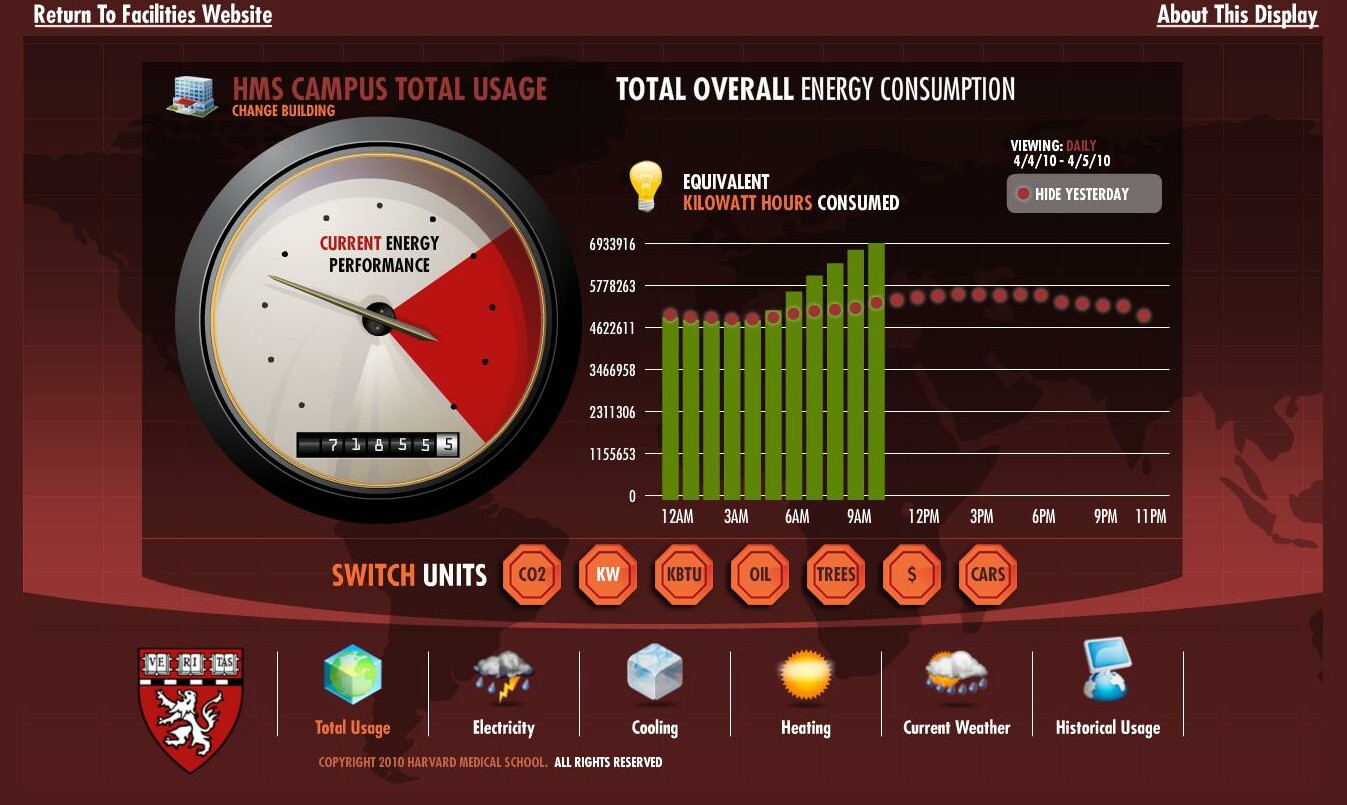
Harvard Medical School Dashboards Energy Usage
Harvard Medical School earlier this year launched an interactive tool which displays energy consumption across its 2.5 million square feet campus in easy to interpret form. The display allows anyone with web access to visualize current energy consumption of several types, and dollarizes the consumption as well as showing its CO2 profile. See the dashboard here.

Sunday, March 28, 2010
One FM’s View of the Immediate Future
As part of an annual scan process we go through in preparation for the beginning of the budget season our organization takes a hard look at the financial world around us. Right now it’s not a pretty picture. Pick an indicator - residential or commercial real estate, manufacturing, job creation – they’re all in trouble. Okay, we know that. But what does it mean for FM's?
Capital to fund projects is going to be hard to come by. The majority of large projects will stay on the back burner as emphasis remains on improving the bottom line through productivity gains and cost savings. Projects that do make it through the approval gauntlet will most certainly be under increased pressure to meet or beat budget and schedule targets. Given current economic indicators corporate capital is expected to remain constrained through at least the next two years.
Commercial real estate will remain in distress through 2011. Default rates continue to rise and are expected to reach 5% this year with the bottom not coming until 2011 at the earliest. That means even tighter credit at a time when many commercial loans are due to reset. Landlords caught in the squeeze are in trouble. Watch your landlord relationships and their financial health. Their risk is your risk. It might be your opportunity as well.
Emphasis on cutting costs and boosting productivity will escalate. Many companies have made the easy cuts and still have to improve to survive, but additional staff cuts run the risk of so deeply depleting the talent pool as to be too risky. For others, the need to improve is a key to competitiveness even if they have so far remained unscathed. Companies will dial up Continuous Improvement initiatives, but the initiatives must demonstrate hard gains through specific metrics. This will include second tier metrics to make certain that credit is not claimed for gains in one sector, cost as an example, at the expense of another, i.e. quality or revenue.
FM service providers are still under pressure. Virtually every firm you depend upon for service or support is under financial duress. Some have improved their position over the last year and most will make it through, but some will not. Keep a close eye on those that are most critical to your operations or present large financial risk should they fail. One way of doing this is to include corporate financial health information in your routine monthly or quarterly contract reviews. They will expect you to be asking so don’t be shy about it. You should be monitoring key ratios, borrowing capacity, credit rating and stock value as a minimum.
Opportunities exist to gain contract concessions. It might be a lease as noted above or renegotiating terms with your largest outsourced service providers. In most cases FM’s will have several of these opportunities. Your goal here is to drive down the cost of the contract in exchange for considerations in their favor such as extending the term of the contract, while maintaining enough resource to get the job done without endangering quality.
Adoption of alternative office strategies will become more common. Even organizations that traditionally have not ventured into this territory will do so. Companies will analyze occupancy and presence data to understand the scale and scope of stranded real estate investment. For companies who need to grow doing so without real estate expansion will become a priority. Densities will increase with shifts in office entitlement policies and standards.
Smart FM’s will watch the scoreboard. You may not consider yourself an economist but now more than ever you need to understand the basics of how business works in this very interdependent world. You should be watching basic market indicators relevant to your business and thinking strategically about risk and opportunity. FM’s should be knocking on the CFO’s door with observations and trends, and proposing actions to take advantage of opportunities and/or mitigate risk. You don’t have to have details. Demonstrating that you are keeping your finger on the pulse and understand what the data potentially means to your business will raise your own stock and protect the company’s as well. Go knock on the door, don’t wait to answer the phone.
Capital to fund projects is going to be hard to come by. The majority of large projects will stay on the back burner as emphasis remains on improving the bottom line through productivity gains and cost savings. Projects that do make it through the approval gauntlet will most certainly be under increased pressure to meet or beat budget and schedule targets. Given current economic indicators corporate capital is expected to remain constrained through at least the next two years.
Commercial real estate will remain in distress through 2011. Default rates continue to rise and are expected to reach 5% this year with the bottom not coming until 2011 at the earliest. That means even tighter credit at a time when many commercial loans are due to reset. Landlords caught in the squeeze are in trouble. Watch your landlord relationships and their financial health. Their risk is your risk. It might be your opportunity as well.
Emphasis on cutting costs and boosting productivity will escalate. Many companies have made the easy cuts and still have to improve to survive, but additional staff cuts run the risk of so deeply depleting the talent pool as to be too risky. For others, the need to improve is a key to competitiveness even if they have so far remained unscathed. Companies will dial up Continuous Improvement initiatives, but the initiatives must demonstrate hard gains through specific metrics. This will include second tier metrics to make certain that credit is not claimed for gains in one sector, cost as an example, at the expense of another, i.e. quality or revenue.
FM service providers are still under pressure. Virtually every firm you depend upon for service or support is under financial duress. Some have improved their position over the last year and most will make it through, but some will not. Keep a close eye on those that are most critical to your operations or present large financial risk should they fail. One way of doing this is to include corporate financial health information in your routine monthly or quarterly contract reviews. They will expect you to be asking so don’t be shy about it. You should be monitoring key ratios, borrowing capacity, credit rating and stock value as a minimum.
Opportunities exist to gain contract concessions. It might be a lease as noted above or renegotiating terms with your largest outsourced service providers. In most cases FM’s will have several of these opportunities. Your goal here is to drive down the cost of the contract in exchange for considerations in their favor such as extending the term of the contract, while maintaining enough resource to get the job done without endangering quality.
Adoption of alternative office strategies will become more common. Even organizations that traditionally have not ventured into this territory will do so. Companies will analyze occupancy and presence data to understand the scale and scope of stranded real estate investment. For companies who need to grow doing so without real estate expansion will become a priority. Densities will increase with shifts in office entitlement policies and standards.
Smart FM’s will watch the scoreboard. You may not consider yourself an economist but now more than ever you need to understand the basics of how business works in this very interdependent world. You should be watching basic market indicators relevant to your business and thinking strategically about risk and opportunity. FM’s should be knocking on the CFO’s door with observations and trends, and proposing actions to take advantage of opportunities and/or mitigate risk. You don’t have to have details. Demonstrating that you are keeping your finger on the pulse and understand what the data potentially means to your business will raise your own stock and protect the company’s as well. Go knock on the door, don’t wait to answer the phone.
Sunday, August 9, 2009
Aligning FM With Enterprise Strategy – Pt. 2
The Strategic Alignment Process
Viewed as a continuum the strategic alignment process differs little from a classic change management process, precisely because that is what it is. Understanding that simple truth helps de-mystify the effort. Some stakeholders will be the same (FM staff, other departments) and some will be a different set of people than you normally work with on change projects (executive staff).
It is also important to recognize where you are in the alignment continuum. Evaluating your organization to determine its current alignment maturity and reaching consensus on this point is notable because it marks the common understanding of your starting point. Understanding the definitions of the various levels provides a roadmap for improving maturity.
| Maturity | Stage | Characteristics |
| Level 1 | Ad Hoc | |
| Level 2 | Commitment | |
| Level 3 | Focus | Alignment team established, focused objectives determined |
| Level 4 | Improvement | Strategy alignment, FM value recognized |
| Level 5 | Optimization | Strategies and adaptation fully integrated |
| Luftman, J., Addressing Business Alignment Maturity | ||
Note in the model depicted above that Level 3 requires a team approach. It is much more beneficial to engage other leaders as willing co-conspirators early on, as opposed to later engagement. Doing so helps lower boundary hurdles, speeds integration and drives recognition of FM value. Also note that it is at this stage that focused objectives are agreed upon. Agreed upon by whom? By the team, including senior non-FM managers with whom you must integrate and by executive leadership. The former will want to make sure that your alignment goals really do align, that they agree to compromises required to achieve alignment and that their organization’s interests are protected; the latter will look to increase gains to the overall bottom line and assure that balance is maintained.
Early on I mentioned the importance of developing a good understanding of FM and corporate strategies and their resulting goals and objectives. Often times FM’s attention is focused on maximizing value in areas FM’s know best, space utilization efficiency or quality of maintenance for example. Those are by definition good things to do, but they likely do little if anything to align the FM organization with the overarching strategic doctrine of the enterprise. In order to begin the alignment process you must understand the starting point and develop a comprehensive gap analysis.
The gap analysis will identify corporate strategies that are not supported, or may be poorly supported by current FM strategy. The basic premise is this: Filling the gaps forces FM to look beyond its’ own needs and plans to identify missed opportunities that it may not have realized exist. Basically the question to ask is, “What can FM do to further progress on these corporate strategies?” The answers to that question will begin to illuminate opportunities.
Next you will develop FM strategies and goals that support corporate initiatives to which you have previously not been a substantial or intentional contributor. By designing FM strategy and plans in a manner that directly and materially supports key corporate strategies you effectively link the two together, thereby increasing the importance and value of FM to the programmatic and economic success of the organization. An important step at this stage is designing Service Level Agreements (
Always an important part of any improvement initiative, Customer Satisfaction is important here as well. “Customer” in this case may refer to executive staff or other internal departments. The point is that after engaging them in the initiative to improve alignment and having developed strategy linkage you must now continually monitor strategy performance and adapt as performance and strategy shifts dictate. In order to do so you should routinely monitor the satisfaction of key stakeholders. By focusing priorities through their lens you will be able to accelerate the value of increased strategy alignment, making continuous changes that demonstrate your attention and agility.
Next week, a case in point.
Sunday, June 7, 2009
European FM Standard – EN15221
When globalization developed momentum it quickly over ran most organization’s ability to track operational and portfolio data in a coherent manner. Recall also that the break up of the Soviet Union both added political instability and introduced new business energy into the Eastern European region. Stir that pot just a bit and you have one very interesting recipe. CRE/FM teams raced to support business expansions in an often times chaotic environment. Making it more difficult was the lack of comparative data. Forget about trying to normalize against Western measures, we often couldn’t normalize between two Eastern countries. Each, it seemed, had their own business calculus. They measured space differently and often something as simple as that had no standard within a country. OK, so what you say? That was then, this is now. Why does that matter?
While multinationals have done a good job of integrating portfolios and operations across national boundaries in the region there has still been a lack of cohesiveness. Standards tended to be determined on a company basis, not on a national or regional basis.
That is changing with the emergence of EN15221, the European standard for FM. With first elements released several years ago it is already well rooted. New elements build on an impressive body of work and expand the reach of standardization. It includes specific standards for Terms and Definitions, FM Agreement, Quality, Classification, Process and Area and Space Measurement. This standard enables consistent, meaningful and actionable information and data tracking across thirty countries on the European continent.
As desirable as the outcome may be, it will not be easy. Thirty countries. Thirty different ways of doing things. All moving to one standard, all having to change long held definitions and methodologies. There’s that word again. Change. I expect there will be a fair amount of “dust in the air” as they say in the construction business, but it will be worth every bit of it when everyone speaks the same business language.
OK, so what you say? That was then, this is now. Why does that matter?
While multinationals have done a good job of integrating portfolios and operations across national boundaries in the region there has still been a lack of cohesiveness. Standards tended to be determined on a company basis, not on a national or regional basis.
That is changing with the emergence of EN15221, the European standard for FM. With first elements released several years ago it is already well rooted. New elements build on an impressive body of work and expand the reach of standardization. It includes specific standards for Terms and Definitions, FM Agreement, Quality, Classification, Process and Area and Space Measurement. This standard enables consistent, meaningful and actionable information and data tracking across thirty countries on the European continent.
As desirable as the outcome may be, it will not be easy. Thirty countries. Thirty different ways of doing things. All moving to one standard, all having to change long held definitions and methodologies. There’s that word again. Change. I expect there will be a fair amount of “dust in the air” as they say in the construction business, but it will be worth every bit of it when everyone speaks the same business language.
Subscribe to:
Posts (Atom)