Every once in a while it is fun to gaze into the crystal ball, not only for the amusement factor but also because it is a strategic activity. Strategic in the sense that you look outside your current circumstances and try to discern likely futures, and doing that can in turn shape the shifts you make in anticipation.
So let’s do a bit of strategic gazing. As we look at the future of Facility Management what do we imagine might be different in the coming years? Here are a few suggestions.
Budgets will be determined at the strategic level and given to FM to prioritize and manage. This shift will be driven by the need for agility in executing corporate priorities and the importance of aligning capital spend and operations in an increasingly complex and integrated technology environment. It recognizes that executive leadership is best positioned to prioritize strategy while business unit leadership is best positioned to prioritize investments within a strategy.
FM will be elevated to the C-Suite. There will be a second “CFO” in the suite, the Chief Facilities Officer (alternatively, the Chief Asset Officer). The sheer value of FM is rising to the level that it demands front office executive attention. As a result, business acumen will become the number one FM executive skill and many FM units will be headed by leaders who do not have a technical background. MBA’s will lead FM, PE’s and professionals will remain in their traditional roles.
Service Level Agreements (SLA’s) will be prioritized to extend asset life cycles. Financial investment in capital assets will be recognized as a significant lever on the overall health of an organization. With this the primary emphasis of SLA’s will be shifted to maximizing the life of assets and contributing to productivity.
Global recession fallout will be with us for the foreseeable future. The forms this takes will be many. Reduced capital availability and higher cost will limit options, placing an emphasis on space efficiency. Coupled with a younger workforce and their work lifestyle expectations the trend towards increased use of alternative office strategies will continue.
The line between FM and IT will continue to blur. Said another way, FM will become more and more dependent upon IT. The mantra will continue to be streamlined processes that operate intuitively and require less and less intervention. By definition that means a more complicated data sharing and dependency environment.
Worker productivity will be the measure for everything. FM value will be stated in productivity terms, including how the workspace is organized and maintained. Service initiatives will support increased productivity and outcomes for most projects and initiatives will be measured and reported. Why? Because productivity is a root issue. It leads directly to revenue, space, cost of services and everything else that affects the bottom line.
Building Information Modeling (BIM) and Integrated Project Delivery (IPD) will be the development vehicle of choice. BIM and IPD are here to stay, and that’s a good thing. BIM contributes to both the development goals of a project and its life long efficiency and sustainability. IPD is simply what it says, a fully integrated approach to delivering projects. It means partnering and working in truly integrated fashion, including sharing risk and rewards. The payoffs are faster delivery, lower first and life cycle costs, higher satisfaction and more opportunity.
Sunday, May 9, 2010


Sunday, May 2, 2010
IPD, BIM, FM, Lean … All in One Place
Recently I have been working on a personal research project, looking to gather some of the more informative and interesting sources into one bundle. You may be aware of most of these, but my contribution to the greater good this week is to put them all in one place, and maybe introduce you to one or two you were not aware of. For those of us who work in the real estate, capital projects and operations side of facilities, these are good sources to have at hand. Naturally, given where the profession is these days, lean, IPD and BIM are prominent.
The National Institute of Building Sciences’ Whole Building Design Guide offers a wealth of information on built environment standards and best practices.
The mission of the Open Standards Consortium for Real Estate (OSCRE) is to deliver global electronic real estate standards. Members often compete in the business arena but collaborate within the OSCRE framework to further the development of standard real estate measurements and tools.
The Building Smart Alliance focuses on building system interoperability and full lifecycle implementation to attain lowest overall operating cost, optimum sustainability, energy conservation and environmental stewardship.
The Journal of Building Information Modeling (JBIM) is a publication of the National Institute of Building Sciences which focuses on Building Information Modeling’s (BIM) application to the lifecycle management of the built environment.
Tradeline, Inc. produces excellent conferences primarily geared towards the academic environment. Register on their site and you have access to a wide array of research reports which will be beneficial regardless of which sector you operate in.
The Construction Users Roundtable is an offshoot of the Business Roundtable. Founded in 2000 its mission is to create a competitive advantage for construction users by focusing on cost effectiveness, improving construction planning and what Owners allow, require, and accept responsibility for on their global construction projects.
The Lean Construction Institute conducts research on project based production management for capital facilities.
The American Society of Quality’s Design and Construction Division works to advance quality and improvement within the industries that provide services to the built environment.
Stanford University’s Center for Integrated Facility Engineering, strives to be the world’s premier academic research center for virtual design and construction. Its focus is research and education, with main objectives to improve schedule performance, cost conformance, sustainability and globalization.
Projects@Work is a good source for project management information and development. Here you will find PM case studies, PM leadership tips, and general information of the profession.
For those interested in learning the basics of Integrated Project Delivery (IPD), you can check out this article at McGraw Hill’s Continuing Education Center.
IPD FAQ’s by the California Council of AIA.
CMAA’s College of Fellows paper entitled Managing Integrated Project Delivery provides insight and understanding that practitioners can build upon. Its ideas are thoughtful and sometimes contradictory, as they should be in an intellectual interchange.
The Building Information Management blog reports on a national IPD study conducted by AIA, pointing to demonstrated efficiencies and cost effectiveness.
Sunday, April 25, 2010
Learn the Right Business Continuity Lessons the Right Way
Monday, April 19, 2010
BIM and IPD Tips to Remember
In the capital projects arena Building Information Modeling (BIM) and Integrated Project Delivery (IPD) are fast becoming the norm instead of the exception. While both have been around for some time now they are reaching critical mass in terms of their acceptance. The reasons why are obvious. Both support shorter construction timelines and that has a direct affect on cost. Just as importantly, both offer improved quality when done correctly (although I personally think BIM has the greater leverage here). As an extra value, BIM provides building operators with full access to all design and specification information on day one, in a way they can actually use immediately and intuitively. For those of you like me who have sometimes waited months to get that all elusive "Building Manual" this alone makes your mouth water.
BIM provides a complete building model, right down to the hanger inserts if you choose to take it that far, and you should. Not only does this modeling provide collision detection before systems are fabricated, it also allows completion of shop drawings in the design process (assuming a IPD methodology where contractors are already on board). Another advantage, especially for more complicated buildings with sophisticated process systems, is the ability to operate the facility virtually before the first backhoe bites the dirt. This allows process system operators and building operators to collaborate on maximizing facility performance and efficiency, and to conduct actual operational training where they interact with system controls exactly as they will in the new completed facility.
IPD is a project delivery method that integrates people, systems, business structures and practices into a process that collaboratively harnesses the talents and insights of all participants to optimize project results, increase value to the owner, reduce waste, and maximize efficiency through all phases of design, fabrication, and construction. From an end-user perspective, IPD improves design team acceptance of the Owner's culture and goals. The keys here are to find the right partners, trust in each other and make good decisions via collaboration, and to adopt fair risk sharing equations.
Here are a few tips to consider when choosing to implement BIM and IPD on your next project:
BIM provides a complete building model, right down to the hanger inserts if you choose to take it that far, and you should. Not only does this modeling provide collision detection before systems are fabricated, it also allows completion of shop drawings in the design process (assuming a IPD methodology where contractors are already on board). Another advantage, especially for more complicated buildings with sophisticated process systems, is the ability to operate the facility virtually before the first backhoe bites the dirt. This allows process system operators and building operators to collaborate on maximizing facility performance and efficiency, and to conduct actual operational training where they interact with system controls exactly as they will in the new completed facility.
IPD is a project delivery method that integrates people, systems, business structures and practices into a process that collaboratively harnesses the talents and insights of all participants to optimize project results, increase value to the owner, reduce waste, and maximize efficiency through all phases of design, fabrication, and construction. From an end-user perspective, IPD improves design team acceptance of the Owner's culture and goals. The keys here are to find the right partners, trust in each other and make good decisions via collaboration, and to adopt fair risk sharing equations.
Here are a few tips to consider when choosing to implement BIM and IPD on your next project:
- Conduct a process mapping exercise with all team members present
- Also conduct a Value Stream Mapping session to identify gaps and opportunities
- Assure that all contracts are tied to project goals with specific measurables agreed to
- Define profit and risk sharing in the contract
- Define allowable Change Order causes in specific language (no design, fit, or fab issues)
- Co-locate the project team for the duration of each team member's involvement
- Make consensus based decisions
- Focus on process flow
- Set target cost early and align incentives
- Provide rapid cost input to design during the design process, not after
- Write all agreements so that the BIM model is owned by the Owner, not the consultants
Wednesday, April 7, 2010
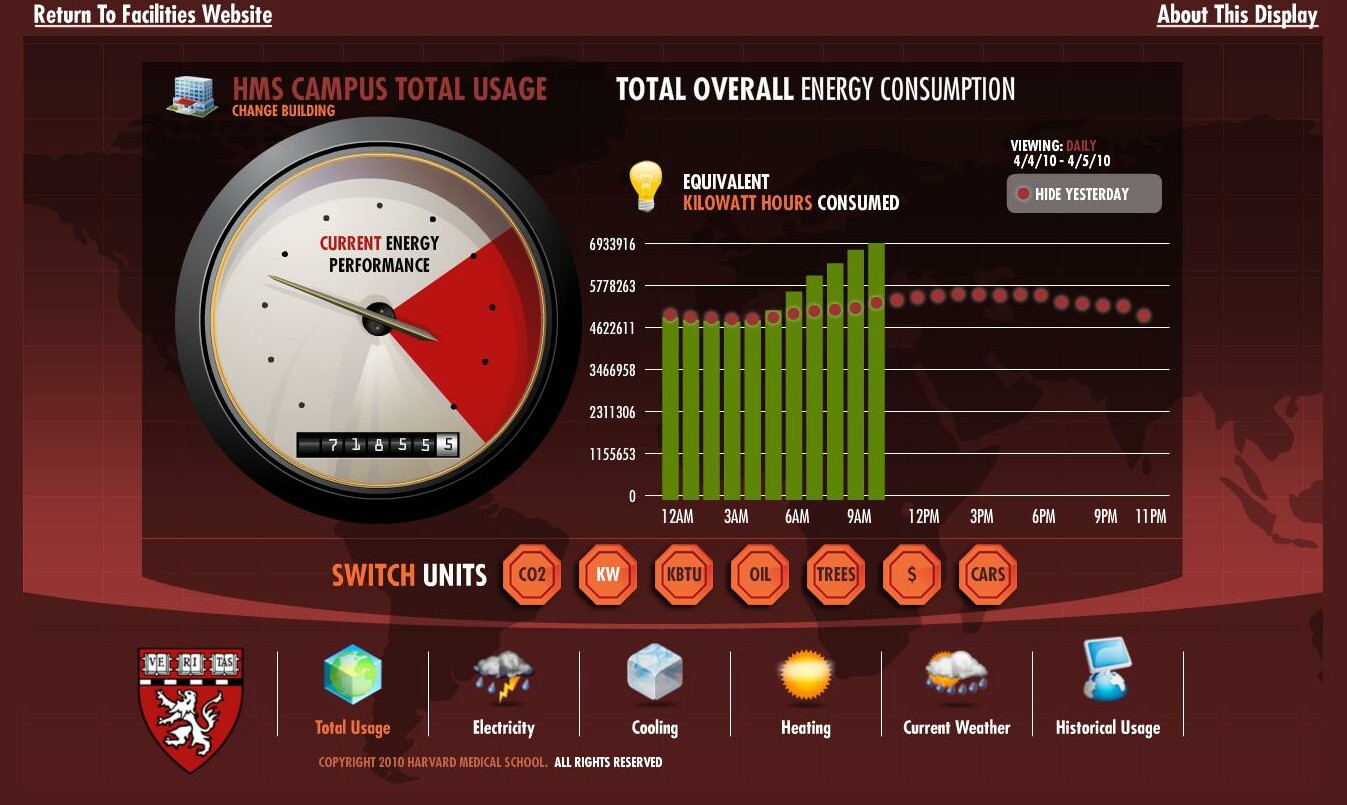
Harvard Medical School Dashboards Energy Usage
Harvard Medical School earlier this year launched an interactive tool which displays energy consumption across its 2.5 million square feet campus in easy to interpret form. The display allows anyone with web access to visualize current energy consumption of several types, and dollarizes the consumption as well as showing its CO2 profile. See the dashboard here.

Subscribe to:
Posts (Atom)